
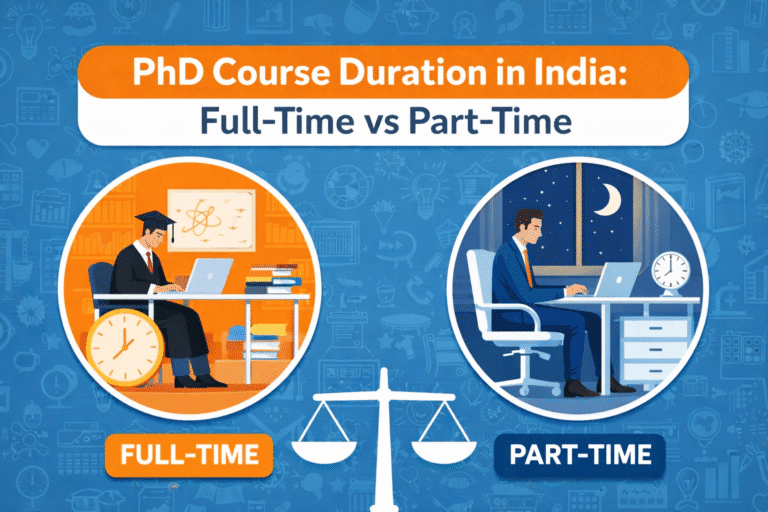
A Doctor of Philosophy (PhD) is the highest qualification for higher education aspirants. A PhD course is your pathway to professions across various domains, including Leadership, Public Policy, Consulting, Marketing, Social Sciences, and other core subjects. The PhD course duration may vary from 3 to 6 years for a full-time program. On the other hand, the part-time PhD programs may take 4-8 years.
Some crucial factors affecting the duration may include university, country and research domain. The other factors influencing the PhD coursework may involve independent surveys and dissertations. Since most subjects in a PhD program require concrete research, the availability of various resources may also impact the collective time needed to complete a PhD course.
PhD Eligibility and Duration
The University Grants Commission (UGC) determines various benchmarks for PhD course durations. Though the academic infrastructure for both Full-Time and Part-Time PhD programs remains the same, requirements involving time and residential constraints may play a crucial role in the completion.
Integrated PhD programs are available now. What’s an integrated PhD program? It’s a course that combines your master’s degree with a PhD. It may take up to 6 years. The advent of Information Technology (IT) has touched upon multiple arenas of our lives. Hence, a few of you with notable time constraints may also opt for the online PhD programs. These courses take 3-5 years. However, kindly note that a few academic settings may not recognise the online PhD programs.
After completing the postgraduate studies, a few of you may wish to delve deep into your academic areas, and this is where a PhD comes into play. It’s a pivotal decision demanding substantial research, commitment, and most essentially, your time, the most valuable resource. In addition to every factor mentioned above, though a range of PhD programs allow a flexible timeline, they also imply a carefully planned timetable that you must abide by.
Eligibility Requirements
Educational Qualification:
- Master’s Degree: The candidate must have completed a postgraduate degree like M.Tech, M.A. or M.Sc. in the chosen stream from a reputed/recognised university. Candidates from the general category require a 55% aggregate, and reserved category candidates may require a 50% aggregate to be eligible.
- 4-year Bachelor’s: A few institutes may accept candidates with distinguished scores in a 4-year Bachelor’s degree with a percentage of 75% or above.
What do the PhD programs involve?
Let’s delve deep into the standard PhD programs available in India.
- Coursework: A compulsory coursework forms the most crucial part of every academic structure, with PhD programs not being an exception. This phase lays the foundation for all that may approach the PhD aspirants, perhaps throughout their journeys.
- Research planning and execution
- Niche (core) subjects
- Key electives
Most universities make it a mandate to complete the coursework before proceeding any further. Most coursework across various PhD programs takes roughly 6-12 months.
2. Examinations and Assessments: Your critical evaluation matters a lot more than you think. Most institutes scrutinise your willingness to research a topic or a set of chapters based on whether and how you qualify for their comprehensive tests. Most of these exams test your core knowledge and how thoroughly you have delved into your PhD subjects.
Many of you may cram for these exams as you did for a few entrance exams in the past. But why? These intellectual challenges may also require a thorough comprehension of your chosen stream. This phase takes 3-6 months.
3. Research Proposition: It’s a phase where you may require an outline of your research projects. In other words, this is where you must render a proposition that outlines:
- Research initiatives
- Pain areas or problems to be covered
- Mode of operation (Method)
- Anticipated results or outputs
- Collective evaluation of your literary piece
You may prepare your research proposition, keeping in mind the above factors and present it. The official beginning of your thesis is subject to the approval of your research proposal by your department or concerned officials. The entire process may take 6 months. It’s a timeline that sees and tests your organisational abilities.
4. Fieldwork, data collection, and compilation: We may call it the most exclusive stage of the program that tests your:
- Experimentation and evaluation skills
- Willingness to work independently and extract results
- Your analytical approaches in settings of varying difficulty levels
- Your case studies and literature
Please note that factors such as tech-savviness and research modules presented to you may highlight your success during and throughout this phase. These factors may determine the total time you require to draw the inference and proceed to the next stage.
5. Thesis: Research completion always takes you to the next step in your PhD education. Which step is it? It’s a step that outlines your hard work, smart work, and corrective findings that you imparted to your academia. You are correct to say that this stage is all about the thesis. This stage and its timeline may vary based on multiple factors that may include but extend beyond your speed, inferences, your supervisors, and how you structure or restructure your literary piece. This phase might take almost 9 months to a year. In short, this is one of the most significant phases in your journey that streamlines the comprehensibility of your research.
6. Viva: This phase marks the outset of your journey to your doctoral degree. This phase involves the aggregates that set you apart, the assessment of your work, the answers that justify your findings and most importantly, the conclusions drawn based on your academic pursuits. This process ends with your doctoral degree.
Factors affecting the PhD Timeline
Multiple factors may play a significant role in rolling out your PhD degree faster than you think or taking longer than you expect.
- Research Subject: Many subjects require a comprehensive evaluation involving lab tests, paradigms, or environments that facilitate a multimodal approach. A few socialistic topics can also take longer than you think for the collection, collation, and ultimate selection. Topics like humanism may require extensive studies, where designing your analytics based on the available data may consume weeks.
2. Clarity, knowledge, domain-specificity: If your knowledge isn’t up to date or requires diversification, you may take extended periods, timelines, settings, and schedules before executing your task list. If innovation, multidisciplinary approaches, and complexity form a crucial part of the stream you have selected, you may require longer than usual to complete your tasks.
3. Institutional policies and university-specific approaches: Each institute and university abides by its internal policies, guidelines, and regulations. Hence, institutional settings and virtualised environments can also determine the assessments and submissions of projects and theses. A single delay in such timelines can reschedule a process and extend your overall PhD period.
4. Supervisory availability and personal engagements: Your immediate supervisors play a crucial role in a range of tasks from scheduling to restructuring of your endeavours. If you are a professional, you may prefer opting for a part-time PhD. Fortunately, a part-time PhD for working professionals may save you money, time, and resources, provided you conclude your search on the most suitable PhD program.
How Relevant are the Online PhD Programs?
Flexible learning might be a habit for a few. However, if you are looking for a part-time PhD for working professionals, online PhD programs may not always be worthwhile. India has zero recognition for online PhD courses. UGC regulations have issued stern guidelines mandating you to opt for full-time programs with regular involvement or a part-time course involving research projects that include coursework and fieldwork.
Key facts about part-time PhD for working professionals:
- It requires no eligibility/entrance exams.
- It offers equal recognition to that of a full-time PhD.
- University-specific exams might be a prerequisite even for experienced/working professionals.
- Even working professionals may require a minimum 55% in their master’s program.
- On the other hand, a minimum of 75% is mandatory in a 4-year undergraduate program.
- Research Proposals and personal interviews may be equally crucial for you as those who are in full-time traditional PhD programs.
- An official No Objection Certificate (NOC) is mandatory from your employer. Yes! UGC makes it compulsory, as the programs you opt for aren’t online or distance learning courses. The timeline requires you to attend research meetings, coursework, and feedback sessions specified by your immediate supervisors.
Conclusion
We continue to cater to marketplace volatility. Hence, we must select a research area that fits our personal interests and market updates. Those into genetic engineering must focus on technological milestones that align with something similar to interventional techniques that offer a vast scope for research and development.
Similarly, even when selecting an institution and university, we must be choosy and prudent since the upcoming years set out to define our progress and directions that rekindle our professional objectives and achievements.
Frequently Asked Questions (FAQ):
1. What’s the score needed for the PhD program?
If you are a candidate with a Master’s Degree, a minimum of 55% is necessary for you. Similarly, candidates who have passed a 4-year Bachelor’s degree, 75% is the minimum score to qualify for a full-time PhD program.
2. May I know the relaxation offered for candidates from reserved categories?
Candidates from reserved and differently-abled categories are eligible for a 5% relaxation in the minimum score requirement. It means candidates holding a master’s degree must secure a minimum percentage of 50%, and aspirants with a 4-year Bachelor’s degree must secure a minimum percentage of 70%.
3. Are aspirants with professional qualifications such as CA, CS, or CMA eligible for a PhD course?
Candidatures such as Chartered Accountancy (CA) from ICAI or other equally recognised institutions are eligible for the PhD programs in their chosen streams.
4. What if a candidate with a Master’s degree from abroad wishes to apply for a PhD program in India?
Applicants with a foreign qualification are eligible to apply for a PhD program in India. They must submit an equivalence certificate from the Association of Indian Universities (AIU).
5. Who is eligible for an exemption from the PhD Entrance Test?
Below is the list of examinations that may offer an exemption to the candidates who have passed them:
DST-INSPIRE, DBT-JRF, GATE, GPAT, ICMR-JRF/SRF, UGC/CSIR-NET (Category 1, 2, or 3), and ICAR-AICE-JRF/SRF (PhD)
6. What about applicants who have passed their Bachelor’s degree in 1984?
Applicants holding an undergraduate program completed by June 4, 1986, are eligible to apply for the PhD program. A few requirements might differ from university to university.
7. What about applicants with a two-year Bachelor’s degree secured before 1990?
Candidatures holding a two-year Bachelor’s degree are eligible for the PhD program. However, they must complete a one-year bridge program to qualify for entry into a PhD program.
8. What about candidates awaiting the exemption confirmation message?
You may receive an exemption confirmation message on your institute’s website/admission microsite on a scheduled day specified by the governing bodies or concerned authorities. Please ensure you submit your exemption documents two days before the exam date.