
As digital applications continue to power business operations, customer engagement, and data processing, application security has become a critical focus for organizations of all sizes. Cyber threats are no longer limited to large enterprises; even small and mid-sized businesses are frequent targets due to misconfigurations, insecure code, and unpatched vulnerabilities.
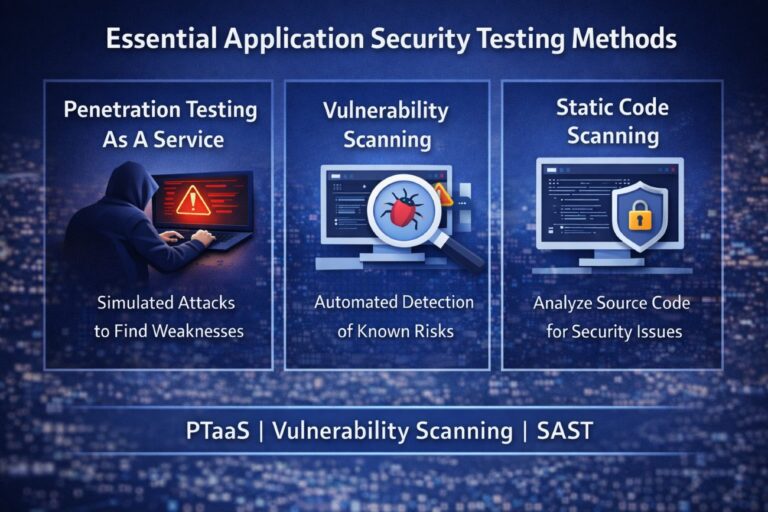
To manage these risks effectively, organizations rely on structured security practices such as penetration testing, vulnerability assessment, and code analysis. This article explains three widely used security approaches—Penetration Testing as a Service, vulnerability scanning, and static code scanning—highlighting how they work and why they matter in modern development environments.
What Is Penetration Testing As A Service?
Penetration Testing As A Service (PTaaS) is a modern approach to security testing that combines expert-led penetration testing with cloud-based delivery and continuous access to results. Unlike traditional penetration tests, which are often conducted annually or on a one-time basis, PTaaS supports more frequent testing aligned with agile development cycles.
In this model, security professionals simulate real-world attacks to identify exploitable weaknesses in applications, infrastructure, or APIs. Findings are typically delivered through online dashboards, allowing teams to track vulnerabilities, remediation progress, and risk trends over time.
PTaaS helps organizations:
- Identify high-impact security weaknesses
- Validate the effectiveness of existing controls
- Improve collaboration between development and security teams
- Support continuous improvement in application security
This approach is especially useful for organizations releasing updates frequently or operating in fast-changing cloud environments.
The Role of Vulnerability Scanning in Application Security
Vulnerability scanning is an automated security process that identifies known weaknesses across applications, systems, and networks. It compares software components and configurations against databases of known vulnerabilities to highlight potential risks.
Unlike penetration testing, which focuses on exploitation, Vulnerability scanning focuses on detection and visibility. It is commonly used on a recurring basis to maintain awareness of an organization’s security posture.
Key benefits of vulnerability scanning include:
- Early identification of outdated or vulnerable software
- Continuous monitoring of application environments
- Faster detection of configuration errors
- Support for compliance and security reporting
Vulnerability scanning is most effective when used consistently and integrated into development or deployment workflows.
Understanding Static Code Scanning
Static code scanning, also known as Static Application Security Testing (SAST), analyzes source code without executing the application. It identifies security flaws, logic errors, and unsafe coding patterns during the development phase.
This approach allows developers to address security issues early, when fixes are less costly and easier to implement. Static code scanning is typically integrated into development environments or CI/CD pipelines to provide real-time feedback.
Static code scanning helps detect:
- Hard-coded credentials and secrets
- Injection vulnerabilities
- Insecure data handling logic
- Violations of secure coding standards
By identifying issues before deployment, organizations reduce the likelihood of vulnerabilities reaching production environments.
How These Security Methods Work Together
Each of these security techniques addresses a different layer of risk. When used together, they provide more comprehensive coverage than any single method alone.
- Penetration Testing As A Service focuses on real-world attack scenarios
- Vulnerability scanning provides ongoing visibility into known risks
- Static code scanning addresses security issues at the source code level
This layered approach improves overall risk management and helps organizations prioritize remediation based on impact and likelihood.
Benefits of a Layered Security Testing Approach
Organizations that combine multiple testing and scanning techniques benefit from stronger security outcomes. Rather than relying on a single assessment, layered testing creates redundancy and improves detection accuracy.
Common advantages include:
- Reduced exposure to known and unknown threats
- Improved development security practices
- Faster remediation cycles
- Better alignment with compliance requirements
Layered security testing supports proactive risk reduction rather than reactive incident response.
Security Testing in Agile and DevOps Environments
Modern development practices emphasize speed and automation. As a result, security testing must adapt to shorter release cycles and continuous deployment models.
Penetration testing services, automated vulnerability scanning, and static code scanning can all be integrated into DevOps workflows. This integration ensures that security remains part of the development lifecycle rather than a final checkpoint.
Security testing in agile environments helps:
- Detect issues early in development
- Prevent repeated vulnerabilities
- Maintain security without slowing innovation
Automation and continuous testing are key to balancing speed and security.
Choosing the Right Security Strategy
The appropriate mix of security testing methods depends on factors such as application complexity, regulatory requirements, and development maturity. Organizations often start with vulnerability scanning and gradually add penetration testing and code analysis as their security programs mature.
Important considerations include:
- Frequency of application updates
- Sensitivity of stored or processed data
- Regulatory and compliance obligations
- Internal security expertise
A well-planned strategy ensures that testing efforts deliver meaningful insights rather than excessive noise.
Conclusion
Application security requires more than a single tool or assessment. Penetration Testing As A Service, vulnerability scanning, and static code scanning each play a distinct role in identifying and managing security risks.
When combined thoughtfully, these approaches help organizations improve visibility, reduce vulnerabilities, and build more secure applications over time. As digital systems continue to evolve, structured and continuous security testing remains a foundational element of responsible application development.