
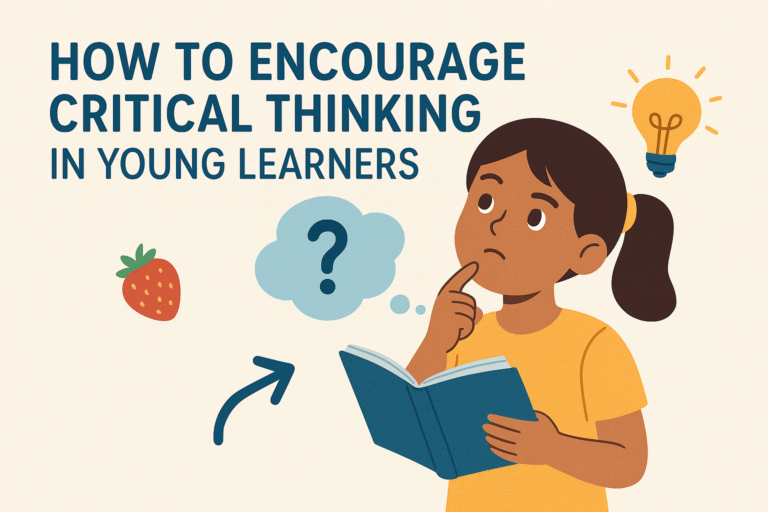
Have you ever watched a child ask why and then ask it again, and again… and again?
It is their way of making sense of the world. Young minds are naturally curious, but curiosity needs direction to grow into something powerful. And that right there is where learning becomes meaningful.
Children are born curious. They tug at your sleeve with endless whys and hows, trying to untangle the world in their own tiny way. That is the spark of critical thinking right there.
But it does not grow on its own. It needs conversation, exploration, and a little bit of wonder.
The real thoughts are in the imagination, not the answer.
Turning curiosity into critical thinking
Curiosity is the seed, but critical thinking is the tree. Young learners need more than facts. They need experiences that make them pause, question, and explore.
In classrooms, homes, and even in Childcare Assignments, encourage them to compare, analyze, and predict.
Encourage them to compare, analyze, and predict. Ask open-ended questions like, “What do you think will happen if…?” or “Why do you think that works?”
It is not about getting the right answer. It is about guiding them to think for themselves. When children see problems from different angles, test their ideas, and reflect on outcomes, they are building skills.
Every small conversation, experiment, or story becomes a stepping stone toward sharper, independent thinking.
Encourage questions… and celebrate them
Children are natural question machines. They ask why, how, and sometimes why not?
Instead of rushing to answer, slow down. Let them explore ideas out loud. Celebrate curiosity, not correctness.
When a child asks, “Why do birds fly?” try responding with, “Hmm, what do you think?”
Giving them space to think critically encourages confidence. They learn that their ideas matter and that thinking deeply is more important than memorizing facts. Every question is a chance to practice reasoning, predicting, and problem-solving.
The secret formula
Play and learn
Critical thinking does not only happen at a desk. Games, puzzles, and imaginative play are powerful tools.
Building a block tower? Ask, “How can we make it stronger?”
Storytime? Pause and ask, “What would you do if you were the character?”
Play turns abstract thinking into something tangible. It teaches cause and effect, experimentation, and creative problem-solving, without even feeling like work. When learning is fun, thinking deeply becomes a natural habit.
Model thinking out loud
Children learn a lot by watching adults. Show them how you solve problems, make decisions, or analyze information.
Narrate your thought process. “I am choosing this route because it is faster, but let’s see if there is a better way.”
This modeling teaches them that thinking is a process, not a magic trick. When they see reasoning in action, they start practicing it themselves, asking questions, considering options, and reflecting on choices.
Encourage reflection and discussion
Critical thinking is not complete until children reflect on what they have learned. After an activity, ask questions like, “What worked? What did not?” or “If you did it again, what would you change?”
Reflection helps them connect experiences, spot patterns, and develop independent thinking.
Even in academic write-ups managed by nursing thesis writing services, this reflective approach is essential, because learning is strongest when we think about how we think.
Discussions teach them to articulate ideas clearly and consider other perspectives. This is where curiosity transforms into true critical thinking.
The role of patience and encouragement
Critical thinking takes time. Children won’t always arrive at deep answers right away, and that is okay. The goal is not to rush them to a conclusion, but to guide them through the process.
Praise their effort, their curiosity, and their ideas. Even if they are wrong, they are thinking, and that is where growth begins.
Every thoughtful pause, every “let’s think about that,” every small moment of exploration is building a skill that will shape who they become. Your patience is part of their learning journey.
Key strategies to encourage critical thinking in young learners
| Strategy | What It Means | How to Apply It | Example Question to Ask |
| Ask Open-Ended Questions | Encourage children to think beyond yes or no answers. | Replace direct answers with guided inquiry. | “What makes you think that?” |
| Model Thinking Out Loud | Show your own reasoning process. | Verbalize how you solve problems and make decisions. | “I’m choosing this because… What would you choose?” |
| Use Play for Problem-Solving | Let learning happen through exploration and creativity. | Use blocks, puzzles, role-play, and storytelling. | “How can we make this tower stronger?” |
| Encourage Reflection | Help children evaluate outcomes and think about improvement. | After activities, discuss what worked and what didn’t. | “If you tried again, what would you change?” |
| Integrate Thinking into Daily Life | Turn everyday tasks into learning opportunities. | Ask reasoning questions during chores, cooking, and travel. | “Which fruit should we buy and why?” |
| Celebrate Curiosity, Not Perfection | Value effort and questions more than quick answers. | Praise thinking strategies instead of correctness. | “I love how you explored different ideas!” |
Frequently asked questions
- At what age can children start learning critical thinking?
Critical thinking naturally develops in early childhood. Kids as young as 3–4 can begin practicing simple reasoning through play, questions, and exploration.
- How can I encourage critical thinking at home?
Use everyday moments, like cooking, shopping, storytelling, and play, to ask open-ended questions. Let the child share ideas, make choices, and reflect on outcomes.
- What if my child gives a “wrong” answer?
That’s perfectly fine! Critical thinking is about the process, not perfection. Instead of correcting, guide them with prompts like, “What made you think that?”
Conclusion
We don’t want children who simply repeat what they are told. We want children who wonder, question, analyze, imagine, and create.
Critical thinking helps young learners grow into confident problem-solvers, people who can handle challenges, adapt to change, and make thoughtful decisions in life. So the next time a child asks something unexpected, instead of giving a quick answer, try asking a question in return.
Because the real goal is not to teach them what to think. It is to show them how to think.