
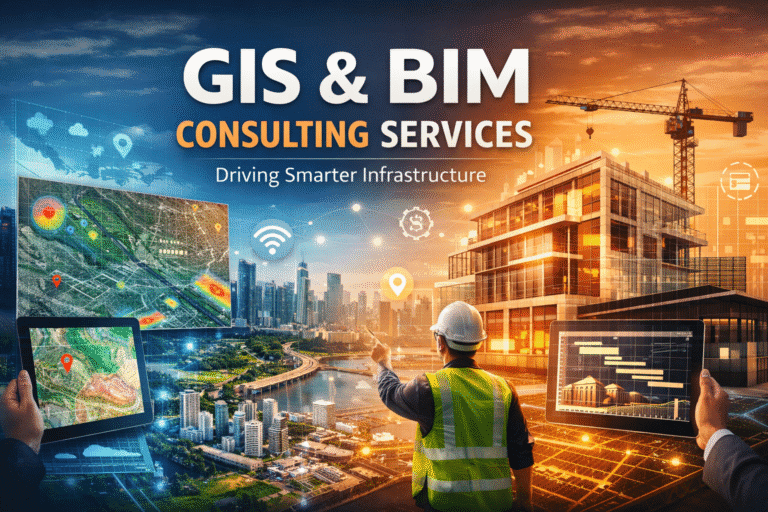
In today’s fast-evolving infrastructure landscape, digital precision and data-driven decision-making are no longer optional — they are essential. This is where GIS & BIM consulting plays a transformative role. By integrating Geographic Information Systems (GIS) and Building Information Modeling (BIM), organizations are able to design, plan, construct, and manage assets more efficiently and intelligently.
From smart cities to transportation networks, GIS & BIM consulting services are helping businesses reduce risks, optimize costs, and enhance collaboration across project lifecycles.
Understanding GIS & BIM Consulting Services
Before exploring the consulting advantages, it is important to understand what GIS and BIM represent individually.
What is GIS?
Geographic Information Systems (GIS) is a technology framework used to capture, store, analyze, and visualize spatial or geographic data. Tools like ArcGIS by Esri enable planners and engineers to analyze terrain, demographics, utilities, environmental conditions, and land use patterns.
GIS answers questions like:
- Where should infrastructure be developed?
- What environmental risks exist in a specific location?
- How will urban expansion impact utilities?
What is BIM?
Building Information Modeling (BIM) is a digital representation of the physical and functional characteristics of a built asset. Platforms such as Autodesk Revit by Autodesk allow architects, engineers, and contractors to create intelligent 3D models enriched with data.
BIM enables:
- 3D modeling and visualization
- Clash detection
- Cost estimation
- Lifecycle asset management
While GIS focuses on large-scale geographic data, BIM concentrates on detailed building-level modeling. Together, they create a powerful ecosystem.
Why GIS & BIM Integration Matters
The integration of GIS and BIM bridges the gap between macro-level geographic insights and micro-level construction details. This unified approach supports smarter planning and operational excellence.
1. Enhanced Planning & Site Selection
GIS provides critical spatial intelligence during early project phases. It helps evaluate terrain suitability, environmental constraints, and regulatory compliance. When combined with BIM models, stakeholders can simulate how structures will interact with real-world geographic conditions.
This ensures better site selection, reduced project delays, and improved regulatory approvals.
2. Improved Collaboration Across Teams
GIS & BIM consulting enables centralized data sharing across architects, engineers, contractors, and government bodies. Cloud-based platforms allow teams to collaborate in real time, minimizing communication gaps.
With integrated workflows:
- Design changes are instantly updated.
- Stakeholders access accurate geospatial context.
- Project conflicts are identified early.
This results in smoother coordination and fewer costly revisions.
3. Cost and Risk Reduction
One of the biggest advantages of GIS & BIM consulting is predictive analysis. GIS helps identify flood zones, seismic risks, and environmental hazards, while BIM ensures precise construction planning.
Through clash detection and scenario modeling:
- Material wastage is reduced.
- Rework is minimized.
- Budget overruns are prevented.
Risk mitigation becomes proactive rather than reactive.
4. Smart City and Infrastructure Development
Governments worldwide are investing heavily in smart infrastructure. GIS & BIM integration supports smart city initiatives by connecting building models with city-wide geospatial systems.
For example:
- Utility networks can be mapped and monitored.
- Transportation systems can be digitally modeled.
- Emergency response planning can be optimized.
This data-driven urban management leads to sustainable and resilient cities.
Key Services Offered in GIS & BIM Consulting Services
Professional GIS & BIM consulting firms typically offer a wide range of services tailored to various industries such as construction, oil & gas, transportation, and utilities.
1. Data Integration & System Implementation
Consultants help integrate GIS databases with BIM platforms to create seamless workflows. This includes:
- Georeferencing BIM models
- Converting CAD data to GIS-compatible formats
- Establishing centralized data repositories
2. 3D & 4D Modeling
Advanced BIM consulting services include 3D visualization and 4D scheduling (time-based simulations). When linked with GIS layers, stakeholders can visualize construction progress within real geographic environments.
3. Asset Lifecycle Management
GIS & BIM consulting supports asset management beyond construction. Facilities managers can monitor maintenance schedules, track infrastructure performance, and plan upgrades efficiently.
This ensures long-term operational efficiency.
4. Digital Twin Development
A growing trend in infrastructure is the creation of digital twins — real-time digital replicas of physical assets. By combining GIS mapping with BIM data, consultants create intelligent models that update dynamically.
Digital twins enable predictive maintenance and performance optimization.
Industries Benefiting from GIS & BIM Consulting
Several sectors are leveraging this integrated approach:
- Construction & Real Estate – Improved design accuracy and reduced delays.
- Transportation – Smart highway, rail, and airport planning.
- Utilities – Better network mapping and outage management.
- Oil & Gas – Enhanced pipeline monitoring and environmental compliance.
- Urban Planning – Data-driven zoning and land-use decisions.
As infrastructure becomes more complex, the demand for GIS & BIM consulting continues to grow.
The Future of GIS & BIM Consulting
The future lies in deeper integration with AI, IoT, and cloud computing. Artificial intelligence will enhance predictive modeling, while IoT sensors will feed real-time data into GIS-BIM systems.
With the rise of automation and smart analytics:
- Infrastructure projects will become more sustainable.
- Operational insights will improve drastically.
- Decision-making will become faster and more precise.
Organizations that adopt GIS & BIM consulting today position themselves for long-term competitive advantage.
Conclusion
GIS & BIM consulting is reshaping the infrastructure ecosystem by merging spatial intelligence with intelligent building modeling. This integration enables better planning, enhanced collaboration, reduced costs, and improved asset management across project lifecycles.
As cities expand and infrastructure demands increase, the synergy between GIS and BIM will continue to drive innovation and efficiency. Businesses, government agencies, and developers that invest in this combined digital strategy will be better equipped to navigate complex projects and deliver sustainable outcomes in the modern built environment.
Read more business related blogs here