
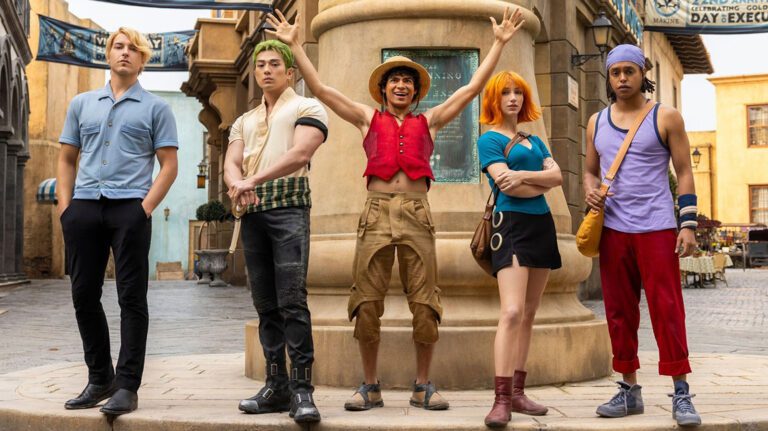
Netflix’s live-action One Piece returns for its second season with a clear goal: to prove that the first season’s success was no fluke. This new chapter doesn’t just continue the Straw Hat crew’s journey—it deepens it, expands the world, and delivers a more confident and emotionally engaging experience overall.
With eight new episodes, Season 2 raises the stakes while refining many of the elements that made the show work in the first place. The result is a series that feels more mature, more cohesive, and more ambitious than before.
A Strong Opening That Sets the Tone
The story begins in Loguetown, a location that carries major historical weight within the world of pirates. Known as the place where the Pirate King met his end, it serves as a symbolic gateway to the Grand Line—the next big stage of the adventure.
One of the most noticeable changes this season is how the story is structured. Instead of strictly following the original sequence, the live-action adaptation rearranges certain events to improve pacing and narrative clarity. These changes feel intentional and, for the most part, successful.
The opening episodes are energetic and engaging, introducing important new characters while reintroducing familiar ones. Figures like Smoker and Tashigi bring a fresh sense of danger and authority, while returning characters such as Buggy and Alvida help maintain continuity with the previous season. The balance between new and old is handled well, making the transition into this new chapter feel natural.
A More Detailed and Connected World
One of Season 2’s biggest strengths is its world-building. The series doesn’t just move from one location to another—it takes time to make each place feel meaningful.
The writers have clearly made an effort to enrich the narrative by adding layers that weren’t as prominent before. Subtle references and early hints about future developments are woven into the story, making the world feel more interconnected. For longtime fans, these moments add extra depth and excitement, while new viewers can still enjoy the story without needing prior knowledge.
This approach helps the series stand out as more than just a straightforward adaptation. It feels like a carefully constructed version of the story that respects its origins while also adapting to a different format.
Music That Strengthens the Experience
The soundtrack continues to play a crucial role in shaping the tone of the series. It successfully blends familiar themes with new compositions, creating a sense of continuity while also introducing fresh elements.
Music is used effectively throughout the season, whether during action scenes, emotional moments, or quieter character-driven sequences. It enhances the atmosphere without overpowering it, helping to create a more immersive experience overall.
This careful use of sound design adds another layer to the storytelling, making key moments more impactful and memorable.
Performances That Keep You Invested
The cast remains one of the strongest aspects of the show. The chemistry between the main crew members feels genuine, and that sense of connection is essential to the story’s success.
Each character is given space to grow, and their interactions feel natural rather than forced. This helps maintain a strong emotional core, even as the plot becomes more complex.
New characters are introduced with confidence and purpose. They don’t feel like simple additions but rather integral parts of the evolving narrative. Some of these introductions also hint at larger storylines that will likely play a bigger role in future seasons, adding a sense of anticipation.
Visual Ambition with Occasional Limitations
As the story expands, so does the scale of what the show tries to achieve visually. From new environments to more complex characters, One Piece Season 2 Flixtor clearly aims higher in terms of production.
For the most part, this ambition pays off. However, there are moments where the visual effects don’t fully match the scale the story is aiming for. Certain scenes, especially those involving more fantastical elements, can feel slightly uneven.
That said, these issues are not constant and don’t significantly detract from the overall experience. They are minor imperfections in an otherwise visually engaging season.
Pacing That’s Mostly Effective
The pacing throughout the season is generally solid, especially in the earlier episodes. The story moves forward with purpose, balancing action, character development, and world-building.
However, the later episodes occasionally feel less consistent. Some plot points could have been given more time to breathe, while others move a bit too quickly. Even so, the overall narrative remains coherent and satisfying.
Emotional Depth That Stands Out
What truly elevates this season is its emotional storytelling. Beyond the action and adventure, the series takes time to explore its characters and their struggles.
Some moments genuinely resonate, adding weight to the journey and making the stakes feel more real. The balance between humor, drama, and action is handled well, ensuring that the story never feels one-dimensional.
These emotional beats are what make the series memorable, turning it from a simple adventure into something more meaningful.
Final Verdict
Season 2 of One Piece successfully builds on the foundation laid by its predecessor. It feels more confident in its storytelling, more detailed in its world-building, and more effective in its emotional moments.
While it does have a few minor flaws—particularly in visual effects and occasional pacing issues—these don’t overshadow what the season accomplishes as a whole.
This is a strong continuation that not only satisfies but also raises expectations for what comes next. If the series continues on this path, it has the potential to become one of the most successful live-action adaptations in recent years.
Rating: 8/10
Blog by Youthfulyarn