
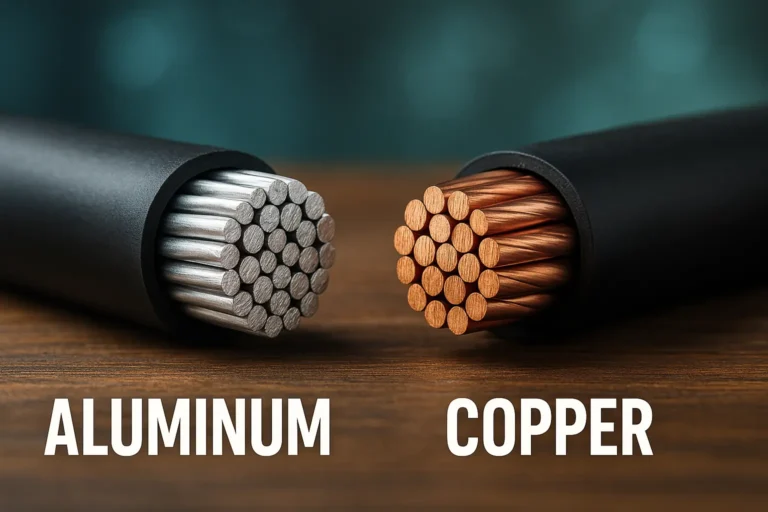
In today’s rapidly expanding power transmission and distribution networks, aluminum cable has become the preferred conductor solution for utilities, EPC contractors, and industrial infrastructure developers. Its excellent balance of conductivity, mechanical performance, and lifecycle cost makes it ideal for overhead lines, distribution feeders, and modern smart grid projects.
As a global manufacturer of overhead conductors and power cables, HNBF Power delivers engineered aluminum cable solutions designed for demanding utility and industrial environments.
This article explains what aluminum cable is, where it is used, and how engineers and procurement teams can select the right specification for long-term network reliability.
Why Aluminum Cable Is the Industry Standard for Power Networks
Aluminum cable has replaced copper in most utility and transmission projects for several practical reasons.
From an engineering perspective, aluminum offers:
- A high conductivity-to-weight ratio
- Lower structural loading on poles and towers
- Better cost stability for large-scale grid projects
- Excellent performance in long-span and overhead installations
For utilities planning new substations, feeders, and distribution upgrades, aluminum cable enables longer spans, reduced installation effort, and lower overall project cost without sacrificing electrical performance.
Key Types of Aluminum Cable Used in Power Systems
Aluminum cable is not a single product category. In real power projects, several specialized conductor designs are used depending on mechanical and electrical requirements.
AAC – All Aluminum Conductor
AAC is mainly applied in short-span distribution networks and urban power lines.
It offers very high electrical conductivity and is suitable where mechanical strength is not the primary constraint.
AAAC – All Aluminum Alloy Conductor
AAAC uses aluminum-magnesium-silicon alloy strands.
Compared with AAC, it provides:
- Higher tensile strength
- Better sag performance
- Improved corrosion resistance
This makes AAAC aluminum cable a common choice for coastal regions and harsh climates.
ACSR – Aluminum Conductor Steel Reinforced
ACSR combines aluminum strands around a steel core.
It is widely used in transmission and sub-transmission lines where mechanical strength, long spans, and wind loading are critical.
ABC – Aerial Bundled Cable
ABC aluminum cable is designed for low-voltage and medium-voltage distribution networks.
It improves safety, reduces power theft, and minimizes faults in dense urban or rural electrification projects.
LV and Concentric Aluminum Power Cables
For underground and service connections, aluminum cable is also manufactured as:
- Low-voltage power cable
- Concentric neutral cable for utility distribution systems
These designs allow utilities to optimize both installation cost and network protection performance.
Engineering Advantages of Aluminum Cable in Transmission and Distribution
Lightweight Structure for Easier Installation
Aluminum cable weighs significantly less than copper for the same current-carrying capacity.
This reduces transportation costs and simplifies tower and pole design.
Optimized Mechanical Performance
Modern aluminum alloy and reinforced designs allow aluminum cable to operate reliably under:
- High wind loads
- Ice accumulation
- Long-span configurations
Strong Thermal and Electrical Capability
Aluminum cable is engineered to maintain stable performance at elevated operating temperatures, enabling utilities to support higher load growth without rebuilding entire lines.
Where Aluminum Cable Is Commonly Used
Aluminum cable is applied across the full power network value chain:
- Overhead transmission lines
- Medium-voltage and low-voltage distribution feeders
- Industrial power supply systems
- Renewable energy interconnection projects
- Rural electrification and grid expansion programs
For EPC contractors, aluminum cable offers flexibility in both overhead and underground designs while supporting fast deployment schedules.
Quality and Compliance Considerations for Utility Buyers
When specifying aluminum cable for utility and infrastructure projects, compliance with international standards is essential.
Manufacturers typically design and test aluminum cable in accordance with standards from organizations such as:
- International Electrotechnical Commission
- ASTM International
These standards define conductor construction, tensile strength, resistance, and test methods to ensure consistent performance and long service life.
For procurement teams, verification of raw material traceability, in-house testing capability, and production quality control is equally important.
How HNBF Power Delivers Reliable Aluminum Cable Solutions
HNBF Power manufactures a full portfolio of aluminum cable products including AAC, AAAC, ACSR, ABC, low-voltage power cable, and concentric cable for utility and industrial applications.
The company focuses on:
- Consistent conductor stranding and compacting technology
- Controlled alloy composition for stable mechanical performance
- Factory testing for electrical resistance, tensile strength, and dimensional accuracy
- Custom design support for project-specific span, load, and environmental requirements
By working closely with utilities, EPC contractors, and engineering consultants, HNBF Power ensures that each aluminum cable solution matches both technical specifications and real installation conditions.
Selection Guide: How to Choose the Right Aluminum Cable
Define Electrical Requirements
Determine rated voltage, current capacity, and operating temperature.
This defines conductor size and construction.
Evaluate Mechanical Loading
Span length, terrain, and weather conditions determine whether AAC, AAAC, or ACSR aluminum cable is most suitable.
Assess Installation Environment
Urban, industrial, coastal, or rural areas may require different insulation systems or corrosion-resistant alloys.
Confirm Compliance and Testing
Always request certification, routine test reports, and production inspection support before final procurement.
Frequently Asked Questions (FAQs)
Q1: Is aluminum cable suitable for high-voltage transmission lines?
Yes. Reinforced and alloy aluminum cable designs such as ACSR and AAAC are widely used in high-voltage and extra-high-voltage overhead transmission systems.
Q2: Does aluminum cable require special connectors compared to copper?
Yes. Aluminum conductors require compatible connectors and proper installation practices to prevent galvanic corrosion and ensure stable electrical contact.
Q3: How long does aluminum cable typically last in outdoor installations?
With proper design and quality manufacturing, aluminum cable can operate reliably for several decades in overhead and underground power networks.
Q4: Is ABC aluminum cable safer than traditional bare conductors?
ABC aluminum cable significantly improves public safety and network reliability by reducing short circuits, accidental contact, and unauthorized connections.
Power Your Next Project with HNBF Power Aluminum Cable
Whether you are upgrading a distribution network, expanding a transmission corridor, or developing a new industrial power system, aluminum cable remains the most practical and scalable conductor solution.
Contact HNBF Power today to discuss your project requirements and receive customized aluminum cable solutions engineered for your grid, your environment, and your long-term performance goals.